Digital Experience
Websites, product configurators, shops and bespoke software tools that make manufactured products digitally tangible.
A premium product deserves a presence that carries it. I build digital experiences that don't just show but let people feel, from narrative scrollytelling to interactive product configurators, technically clean and maintainable. Specific tools are built spec-driven and AI-assisted, from a clear specification quickly to working, maintainable software.
WHAT YOU GET
- → Premium websites: full brand presence, performant and SEO-clean
- → Scrollytelling microsites: narrative and focused on a single product
- → Product configurators & shops: interactive, with Mollie/Stripe integration
- → Software development on demand: specific tools and workflows, built spec-driven and AI-assisted
- → Connected-product integration: dashboards, app and data interfaces for smart devices
PROCESS
- Briefing call (30 minutes, free)
- Concept, architecture and quote
- Implementation with interim builds for review
- Launch, handover and optional ongoing maintenance
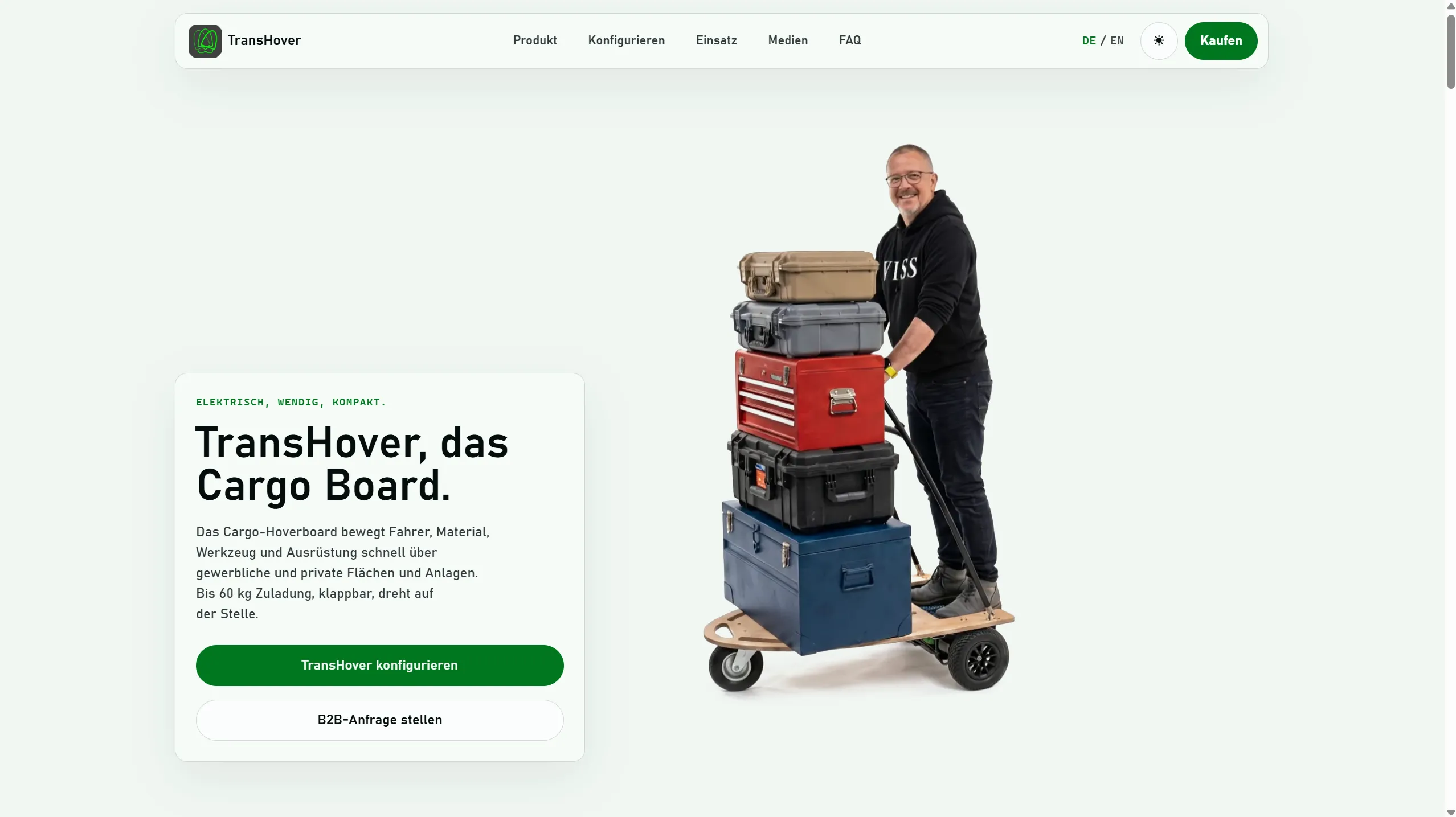
Web presence and shop for electric hoverboard trailers: concept, design, development and operations on behalf of TransHover GmbH.
THE TASK
A new product that needs explaining requires a presence that does three things at once: show the brand, make the product understandable and sell it directly. And all of that for exactly one product. Off-the-shelf shop systems are a poor fit here: too much platform overhead, running costs and template constraints for a single-product sale that must be legally sound (German button rule, GDPR).
APPROACH
A fully custom-built shop, tailored precisely to this one product: a static Astro site with targeted server endpoints. Fast, SEO-clean product pages, configuration and checkout without detours, and server-side price calculation where the amount shown is guaranteed to be the amount charged. Payments via Mollie, transactional order e-mails, content editing without a developer through a Git-based CMS.
CHALLENGES
- → Displayed === charged: every price component from one shared source for client and server (§ 312j BGB)
- → Bot defence without friction for real customers: honeypot plus rate limiting, IP addresses only as hashes
- → Content Security Policy with script hashes instead of blanket allowances
- → GDPR without a consent banner: no trackers, personal data only where needed and documented
RESULT
Live at transhover.com: a purchasable shop in German and English, without a cookie banner, with hardened security headers and a documented data flow, from first sketch to go-live from a single source.
TECHNICAL EXECUTION
- → Astro + TypeScript, statically generated with API endpoints on Netlify
- → Mollie payment integration: webhook with API re-fetch and idempotency claim
- → One Zod schema for client AND server validation, locale-aware error messages
- → Rate limiting and order store via Netlify Blobs, IPs only as SHA-256 hashes
- → CSP with script hashes, self-hosted fonts, transactional e-mails via Resend
WHAT STANDS OUT
Security and privacy as a quality feature rather than an afterthought: server-side price kernel, idempotent payment webhooks with API verification, hash-based CSP. A shop that runs entirely without tracking.
SKILLS IN THIS PROJECT
Product and client: TransHover GmbH. My role: concept, design, development and operations of website and shop, plus product visualisation for marketing. transhover.com ↗
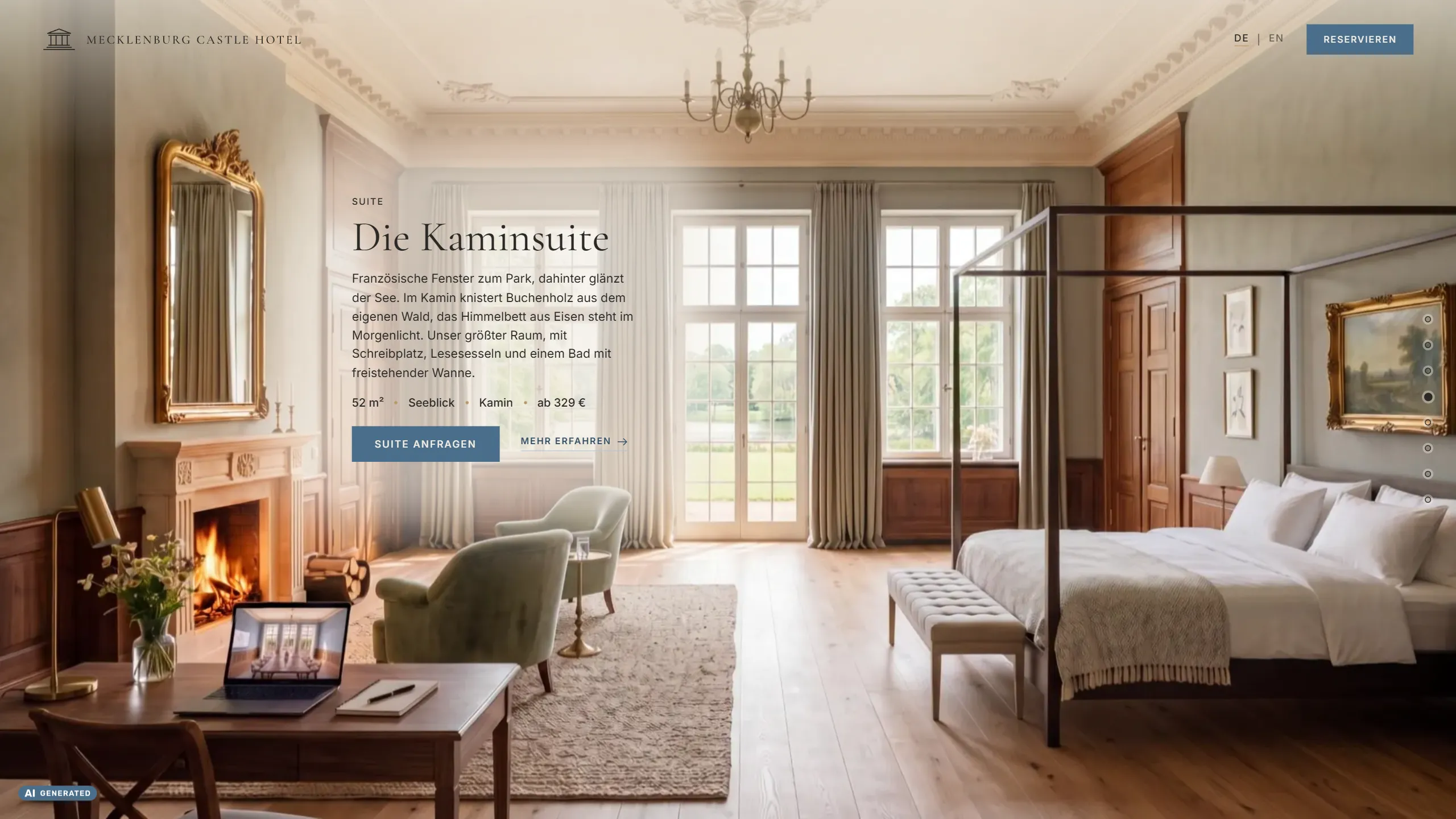
A website as a walk-through: visitors don't scroll down, they scroll into the picture and move through rooms. For hotels, holiday homes, showrooms, sites and products that come alive in space.
THE TASK
Anyone who rents out rooms or sells properties is selling atmosphere: the arrival, the way through the house, the view from the window. Most websites, however, show images one below the other, and visitors have to piece the whole thing together themselves.
APPROACH
This project shows a different way of scrolling, which I call horizontal scrolling: you don't scroll from top to bottom, but into the picture and back out again, moving through the rooms as you go. The hotel on the site is a placeholder. In a client project, the client's real rooms, spaces and outdoor areas take its place.
CHALLENGES
- → Organic rather than to scale: visitors move smoothly from room to room without having to cover the real distances inside the building. They see the stations that matter to them, in an order that feels natural.
- → Logical transitions instead of morphing: many AI websites simply generate a video transition from two photos. The result morphs pointlessly from one room into the next, walls blur, furniture transforms. Here, every transition is carefully planned. Where two rooms don't flow into each other, an intermediate station explains the way. The lobby with three doors, for example, doesn't exist like this in the real house, yet to the viewer it feels self-evident: they choose a door and walk through it.
- → Real images, added paths: in a client project, the stations where visitors stop show the house's real photos. Only the movements in between are created with AI support. This keeps the offer honest and turns the way there into an experience.
- → Automatic, yet controllable: unlike classic scrollytelling, the transition continues on its own as soon as the visitor starts scrolling and stops automatically at the next station. Along the way, they can speed up or turn back. Texts, prices and details appear in the picture, matching the room they are standing in.
RESULT
A visit to the house as one continuous camera ride that guests steer themselves, with room choice at the door and all information in the right place.
TECHNICAL EXECUTION
- → Astro + TypeScript, statically generated on Netlify
- → Canvas player with single frames instead of video, forwards and backwards
- → No cookies or tracking, AI content labelled under the AI Act
WHAT STANDS OUT
The principle fits wherever space and atmosphere sell: hotels, holiday apartments, houseboats and tiny houses, showrooms and exhibitions, outdoor and industrial sites. Larger products such as boats, vehicles or machines can be walked through this way, too. Even small products benefit: instead of showing a vase in a grid, visitors move through an apartment from one spot to the next, turn the vase as they scroll and read the text right in the picture. It is less suitable for sites that mainly offer quick comparisons or large product ranges. There, the classic list remains the better choice.
SKILLS IN THIS PROJECT
My own showcase project, images and camera rides created with AI support. My role: concept, design, imagery and development. mecklenburg-castle-hotel.netlify.app ↗